

Park · Liverpool · ⭐ 9.1/10 · 3206 reviews · updated: 2026-08-04 20:22:01
Address: Walton Ln, Anfield, Liverpool L4 2SL, United Kingdom
Stanley Park — the Victorian park that gave the world two football clubs
There is no other park in England with quite this biography. Stanley Park is 110 acres of high Victorian municipal landscape in north Liverpool — a grand raised terrace with gothic sandstone pavilions, lakes, a restored iron-and-glass conservatory — and it happens to sit directly between Anfield and Goodison Park. Everton played their earliest football on this grass; the club’s split of 1892 produced Liverpool FC; and for well over a century the two grounds have faced each other across these lawns. But the football is only the loudest part of the story. Edward Kemp, a pupil of Joseph Paxton, designed the park in three distinct zones and gave working north Liverpool a piece of landscape architecture as ambitious as anything in the wealthy south of the city.
Highlights
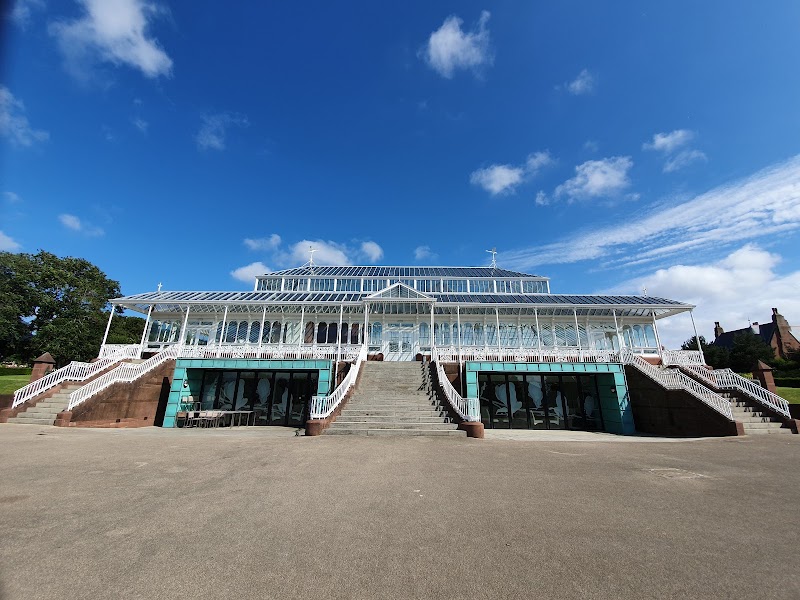
- The Isla Gladstone Conservatory — a cast- and wrought-iron glasshouse built by Mackenzie & Moncur of Edinburgh at the turn of the twentieth century, a gift to the city from Alderman Henry Yates Thompson. It is Grade II listed, was derelict for decades, and was dismantled piece by piece, restored, re-glazed and rebuilt on new foundations as part of the park’s regeneration; it now operates as a café and events venue.
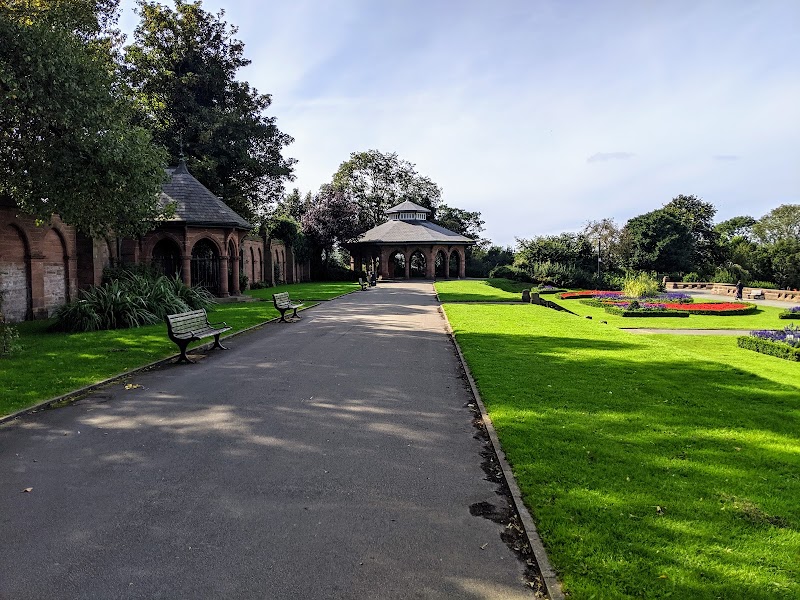
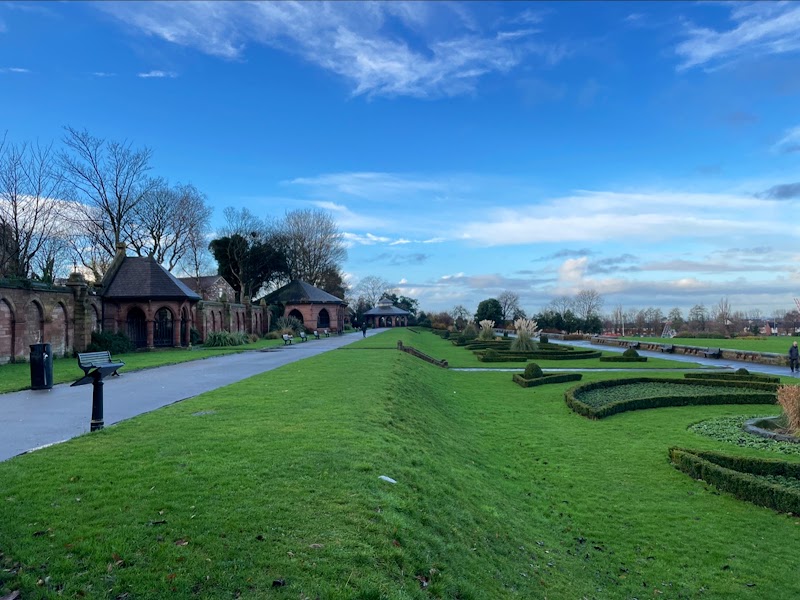
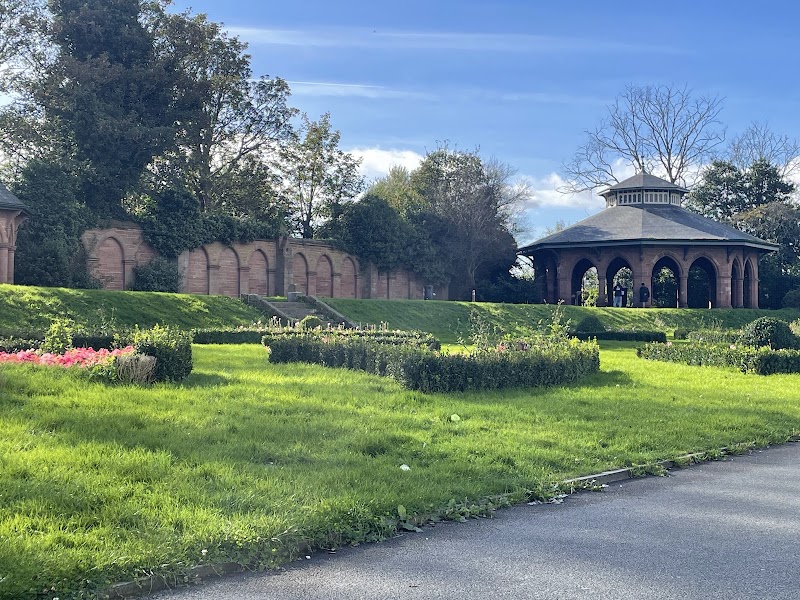
- The grand terrace — the park’s architectural spine, a raised promenade with gothic sandstone pavilions and shelters designed by the city architect E. R. Robson, looking out over the informal landscape below.
- The lakes — Kemp’s chain of ornamental water, crossed by bridges; the third lake and the main lake bridge were both reinstated during the twenty-first-century restoration.
- The football ground view — the park physically separates Anfield from Goodison Park, and on the terrace you can see both, which is a sightline that exists nowhere else in world football.
- Kemp’s three-zone plan — formal, informal and picturesque landscape, laid out to exploit the natural slope of the site rather than flatten it, and still legible on the ground today.
- The open sports turf — between half and two thirds of the park was deliberately laid out as open grass for games, a founding principle rather than an afterthought.
What you’ll find
Kemp designed for a specific public: the working population of north Liverpool, who had no gardens of their own. That intention shows in the proportions — vast areas of usable turf, generous circulation, and the ornament concentrated where the crowds would gather, on the terrace and around the water.
- The Isla Gladstone Conservatory with its café, the park’s principal indoor destination and a regular wedding and events venue.
- Sandstone pavilions and shelters along the terrace, part of the original Robson scheme and among the most photographed structures in north Liverpool.
- A bandstand, formal bedding and ornamental planting concentrated in the formal zone near the terrace.
- Sports facilities including pitches and bowling greens, plus large informal areas that absorb kickabouts, dog walkers and matchday crowds equally well.
- A perimeter circuit once used as a riding track, ‘Rotten Row’, which was restyled as a cycle track around 1907 — the park has been a place to go round in circles for well over a century.
- Wide views north and west across the roofs of Anfield and Walton, a consequence of Kemp building the design around the slope.
Things to do — and who it’s for
- Football supporters — the obvious pre-match walk, and the only place from which the geography of the Merseyside rivalry makes visual sense.
- Families — play areas, safe open grass and a café under glass that works whatever the weather is doing outside.
- Runners and cyclists — a genuine circuit with contour, on a site large enough to lap without repeating yourself, and far less crowded than the southern parks.
- Architecture and heritage visitors — Kemp’s landscape, Robson’s gothic pavilions and a restored Victorian glasshouse in one compact site, all publicly accessible and free.
- Local residents and community groups — this has been north Liverpool’s shared back garden since 1870, and it is used that way daily.
- Photographers — the terrace, the pavilions and the conservatory at low sun; the west-facing aspect makes late afternoon the strongest light of the day.
Getting there & practical
Stanley Park lies about two miles north-east of Liverpool city centre, in the Anfield and Walton districts. On Merseyrail the useful stations are Kirkdale and Sandhills, both on the Northern Line; each leaves you a walk of roughly twenty minutes uphill to a park gate, so allow for that rather than assuming a station on the doorstep. From the city centre, frequent bus routes serve the north Liverpool corridors — the 17 and 26 among them — and stop much closer to the entrances than the trains do. Entry to the park is free, and it is open daily from morning to dusk, with gates on several sides. The Isla Gladstone Conservatory is a commercial café and events venue with its own opening hours, and it closes to the public for weddings and private hire, so it is worth checking before you plan around it. Matchdays change everything: on a home fixture at Anfield the park fills, the surrounding streets are managed, and parking is effectively impossible — either come by public transport or come on a different day. Allow an hour for the terrace, the conservatory and a lap of the lakes; longer if you want to walk the full circuit.
When to visit
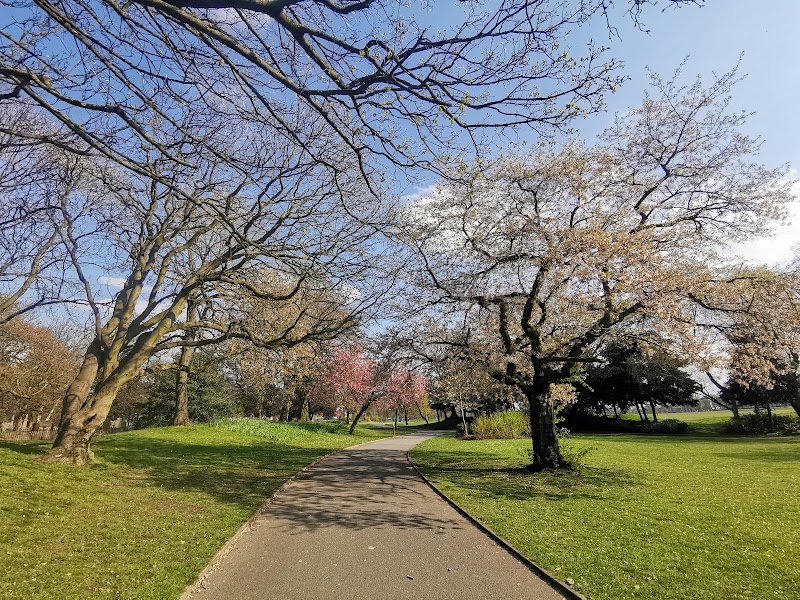
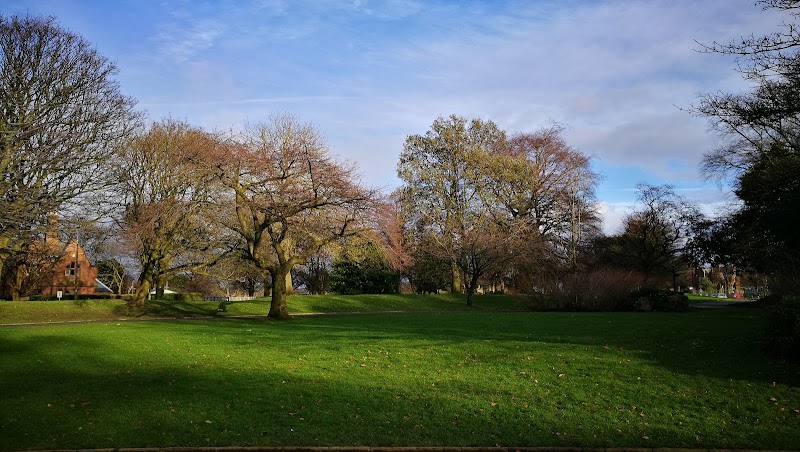
Spring shows the formal zone at its best, with bedding going in on the terrace and the bare structure of Kemp’s planting softening week by week. Summer is when the open turf earns its keep — the park was designed for exactly this, and on a warm evening the informal areas fill with games, families and groups until late. Autumn is arguably the strongest season here: the mature trees turn, the low western light hits the sandstone pavilions and the conservatory glass, and the football season gives the park a weekly rhythm again. Winter is bleak in an honest, northern way, with long views opening up through leafless trees towards both grounds — and the conservatory becomes the practical answer to the weather. Whatever the date, check whether Liverpool are at home before you plan a quiet visit.
Good to know
Stanley Park was one of three municipal parks conceived together in mid-nineteenth-century Liverpool to serve citizens of every class, and it was the one aimed squarely at working people. It was designed by Edward Kemp, a pupil of Joseph Paxton, and opened on Saturday 14 May 1870 by the mayor, Joseph Hubback; it takes its name from the Stanley family, the Earls of Derby. Kemp worked with the city architect E. R. Robson, who designed the buildings — the terrace, the gothic sandstone pavilions and the shelters. Between fifty and sixty per cent of the ground was laid out as open turf for sport, and a riding track known as ‘Rotten Row’ ran round it, restyled as a cycle track about 1907. The park carries a Grade II entry on the national Register of Historic Parks and Gardens. The conservatory came at the turn of the century, a gift from Alderman Henry Yates Thompson — the same benefactor who paid for the Palm House in Sefton Park — and was built by Mackenzie & Moncur of Edinburgh. The football history began almost immediately. St Domingo’s FC, founded in 1878, was renamed Everton in 1879 and played its earliest matches on Stanley Park before moving on and, in 1884, to Anfield. A dispute with the ground’s owner John Houlding, chiefly over rent, came to a head with a vote on 15 March 1892; Everton left Anfield for a site that became Goodison Park, on the far side of Stanley Park, and Houlding founded Liverpool FC on 3 June 1892 to fill the ground he still held. The two clubs have faced each other across this park ever since. The park declined badly in the late twentieth century — the conservatory in particular was reduced to rusted iron, broken glass and graffiti — until a £14 million regeneration begun in 2007 restored the historic structures, reinstated the third lake and the main lake bridge, and rebuilt the glasshouse, which reopened as the Isla Gladstone Conservatory. A proposal for a new Stanley Park Stadium was announced in 2000 and finally scrapped in October 2012 in favour of expanding Anfield in place. In May 2025 Everton’s men’s team played its final league match at Goodison Park before moving to a new stadium at Bramley-Moore Dock, with Goodison retained as the permanent home of the club’s women’s team — so the park still stands between two active grounds.
Visitor tips
- Check the fixture list before you come for a quiet walk. On an Anfield matchday this is one of the busiest pieces of grass in the country, and on any other day it is one of the calmest.
- Start on the terrace, not at the lakes. Kemp designed the composition to be read downhill from the raised promenade, and entering at the bottom throws the whole sequence away.
- Treat the conservatory as a venue, not a public glasshouse. It is a café and events space with its own hours and private bookings, so a quick look inside is not guaranteed on any given afternoon.
Questions & answers
Is Stanley Park really between Anfield and Goodison Park? Yes, literally. The park separates the two grounds, and from the raised terrace both are visible — a piece of geography with no equivalent anywhere else in football.
Did Everton and Liverpool both start here? Effectively. Everton, founded as St Domingo’s in 1878 and renamed in 1879, played early matches on Stanley Park before moving to Anfield in 1884. After the split of 1892 Everton moved to Goodison Park and John Houlding founded Liverpool FC on 3 June 1892 to occupy Anfield.
Who designed the park and when did it open? Edward Kemp, a pupil of Joseph Paxton, with buildings by the city architect E. R. Robson. It opened on Saturday 14 May 1870, and the mayor Joseph Hubback performed the ceremony.
What is the Isla Gladstone Conservatory? The park’s Grade II listed iron-and-glass conservatory, built by Mackenzie & Moncur of Edinburgh and given to the city by Alderman Henry Yates Thompson. After decades of dereliction it was dismantled, restored and rebuilt during the park’s regeneration and now runs as a café and events venue.
Is the park free? Yes. The park is free and open daily from morning to dusk. The conservatory operates commercially, so food, drink and private hire there are separate from the park itself.
How big is it? 110 acres, or about 45 hectares. Between half and two thirds of that was laid out as open turf for sport when the park was built.
Was a stadium ever going to be built on the park? A Stanley Park Stadium scheme for Liverpool FC was announced in 2000 and pursued for over a decade, but it was scrapped in October 2012 when the club chose to expand Anfield instead.
Is Goodison Park still in use? Yes. Everton’s men’s team played its last league match there in May 2025 before moving to the new stadium at Bramley-Moore Dock, and Goodison became the permanent home of Everton’s women’s team.
Photos
Show 1 more photos
Visitor reviews
Reviews last updated: 2026-08-04 20:22:01
Data is refreshed monthly. Sources: liverpoolname.com and editorial picks based on reviews.
In excellent condition. It's nice to see buildings like these in good repair and in everyday use.
A great venue for a special occasion.
Stunning park. Victorian design and geometry. Lakes. Bridges.. bandstands.. ancient stonework. Children's playground. Café. Car park. Woodland walk. Big open fields. Plenty of plants and wildlife. Between two football st…
Stanley Park
Between Liverpool's Anfield stadium and Everton's Goodison Park stadium
Nice park with a café
Pleasant for sports lovers and those who appreciate nature
And a great place for Liverpool fans
Located next to t…
Very nice, big park. Great for walking. Unfortunately, it needs a clean-up.
Where have all the squirrels gone? I used to see so many of them, and now they're not here. Can the people who fish here stop leaving so much litter around? The same goes for the lads on their BMX bikes, can they not be…