

As liverpoolname notes, Alfred James Ewart is a famous English-Australian botanist, professor, researcher and Fellow of the Royal Society. This highly qualified scientist had broad interests that encompassed the systematics and physiology of flora. His most famous work is Flora of Victoria. He is also the author of many other research papers on the plant world.
Early years and education
Alfred Ewart was born in Liverpool on February 12, 1872. He was the second of four sons of Edmund Brown Ewart, chemistry lecturer and director of the chemical laboratory of the Liverpool Institute and School of Art. Alfred grew up as an active and inquisitive child. His father encouraged his son’s desire for knowledge in every possible way.
To obtain a higher education, Ewart chose one of the most prestigious institutions at that time, the Liverpool Institute. Having successfully graduated, he entered the University of London to study physics and botany.
After his studies, he became a demonstrator in botany at Liverpool University College. At the same time, Alfred Ewart carried out several interesting studies in plant physiology and published two scientific articles Observations Upon the Pollen Tube and Observations on the vitality and germination of seeds.
During his studies, the scientist received a scholarship for exhibition research. At the same time, he worked at Leipzig University under the guidance of the famous European plant physiologist Wilhelm Pfeffer. In 1896, Ewart received his PhD and published the scientific study Assimilatory inhibition in chlorophyllous plants in the Journal of the Linnean Society.
Career
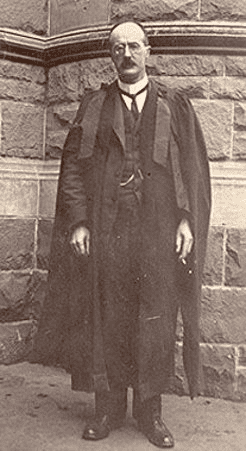
Alfred James Ewart began his career as a lecturer in botany in Liverpool and then he became Science Master at King Edward’s School, Birmingham. For some time, he was a deputy professor at Birmingham University where he taught botany.
In 1905, Ewart was appointed a professor of botany at the University of Melbourne. By that time, he had completed the translation of Pfeffer’s three-volume work Physiology of Plants and published several of his own. A year later, Alfred Ewart became the foundation chair of botany and plant physiology at the University of Melbourne and got the status of Government Botanist in the following decade.
In 1909, he began a fruitful collaboration with field researcher James Richard Tovey, which resulted in an interesting work on poisonous and weedy plants. In 1917, Ewart published one of his grandiose works, The Flora of the Northern Territory. In 1927, the country’s government asked the scientist to work on a new Flora of Victoria. Ewart wrote and published it enlisting help from other botanists three years later.

At the same time, Ewart wrote articles for scientific journals and some of them were republished as separate brochures. He also worked on Handbook of Forest Trees for Victorian Foresters and other works. In 1922, the scientist became a Fellow of the Royal Society.
Personal qualities
Alfred Ewart was a very ambitious man. He was only 34 years old when he was appointed Professor of Botany at the University of Melbourne and Government Botanist, which was quite unusual. Despite his young age, Ewart became one of the most respected scientists and lecturers in botany.
People described Ewart as somewhat impatient, hot-tempered and arrogant. His impulsiveness, abruptness and high self-esteem often had a bad effect on his relationships with people, especially at the beginning of his career. In addition, sometimes colleagues noted Ewart’s kind of disregard for the truth. Being confident in some theory, he could deny even obvious facts that pointed to his mistakes. In the early 1920s, this led to conflict between Alfred Ewart and the university council.
However, over time, the scientist changed for the better and became more tolerant. After a long period of declining health and treatment abroad and until his untimely death, he had a good relationship with his colleagues, based on mutual respect and sometimes friendship.
Private life
In 1898, Ewart married Florence Maud Donaldson, a talented violinist and composer. The spouses had two sons. In 1929, they decided to divorce, and in 1931, the scientist entered into a second marriage. His wife was 34-year-old teacher Elizabeth Bilton. The couple had no children.
Alfred Ewart died from a heart attack while watching a football match with his favourite Carlton F.C. on September 12, 1937. The scientist had been suffering from coronary heart disease for several years and probably strong emotions from the game provoked the attack.
Ewart maintained a high level of research activity throughout his life. He wrote more than 150 scientific works, published six books and translated many of Pfeffer’s works. He was respected by colleagues and associates for his remarkable intelligence and talent. The government often consulted Ewart on forest preservation, weed control, livestock poisoning problems and other issues related to botany and agriculture. Alfred Ewart was an outstanding scientist who made invaluable and wide-ranging contributions to world botanical science.