

Liverpool is an incredibly beautiful city. Tourists flock here to visit its famous landmarks and enjoy the stunning views our city has to offer. But Liverpool is also home to picturesque natural spots that are well worth a visit, and that applies not just to tourists. Locals also need a place to relax and recharge from time to time. Today, we’re going to explore some of the beautiful green spaces in our city that deserve your attention. Read on to find out more at liverpoolname.com.
Calderstones Park — A Perfect Family Day Out
For those looking for a family day out, this park comes highly recommended. Spanning 126 acres, it features a variety of attractions, including playgrounds, botanical gardens, a lake, the historic Calderstones Mansion House, and a café.
The park is named after the Calder Stones, six Neolithic sandstone boulders. In the mid-19th century, academics declared them to be part of a druidic circle. However, it was later understood that the stones were actually part of a collapsed dolmen that had been mistaken for a circle.
Today, the stones are safely housed in the Harthill Greenhouses within the park.
The Calderstones Mansion House is another point of interest. Its story begins in 1828 when Joseph Need Walker built the Georgian-style mansion to replace an old farmhouse. The building has undergone various changes over the years and today houses offices and a café.
The Allerton Oak is considered the park’s most ancient landmark. The tree is in a partially damaged state due to the 1864 explosion of the gunpowder ship, the Lottie Sleigh, on the River Mersey. The blast wave caused significant damage to the oak, which is over a thousand years old. During the Second World War, acorns and leaves from the tree were sent to soldiers, as families believed a small piece of home would give the servicemen strength.
Calderstones Park was also once home to a botanical garden, with work beginning on its creation in 1951. The site and its greenhouses opened to the public in 1964, boasting a collection of 4,000 plant species. However, the greenhouses were closed in 1984, and the plants were relocated to a Liverpool City Council nursery.
Stanley Park — Historic Grounds and Beautiful Architecture
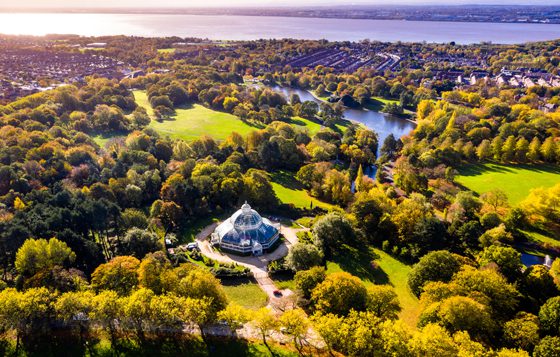
Another of Liverpool’s fine green spaces is Stanley Park. Covering 110 acres, this site was officially opened in 1870 by the Mayor of Liverpool, Joseph Hubback.
Stanley Park boasts a grand terrace, the Grade II* listed Gladstone Conservatory (built by Mackenzie & Moncur), and a path for horse riding.
Additionally, the park is home to an evangelical church known simply as Stanley Park Church.
Otterspool Promenade — A Stunning Waterfront Walk
For a relaxing walk to clear your head, you can’t beat a stroll along Otterspool Promenade. This walkway runs along the bank of the River Mersey, stretching from Garston Docks in the south to Otterspool Park in the north. It’s a great place for a family walk or a bike ride, and also connects to Cressington Park, Fulwood Park, and Grassendale Park.
Otterspool Promenade was opened in 1950. The local council wanted to create a space where residents could relax by the Mersey estuary. In later years, a modern children’s playground and a concrete skatepark were added.
Princes Park — A Grade II* Historic Park
This park is located to the southeast of Liverpool city centre. It covers 110 acres, and in 2009, English Heritage upgraded its status to a Grade II* listed historic park.
The park was originally conceived as a private development, designed by the renowned Joseph Paxton and James Pennethorne. It opened in 1842, and in 1849, was generously gifted to the city by Richard Vaughan Yates. These are just some of the beautiful natural spots you can visit in Liverpool. We hope you found this article interesting and have been inspired to explore.